How to train AI on your company data: RAG vs fine-tuning explained
Want ChatGPT or Claude to actually know your business? How RAG and fine-tuning work, which one you need, and how to do it without leaking data.
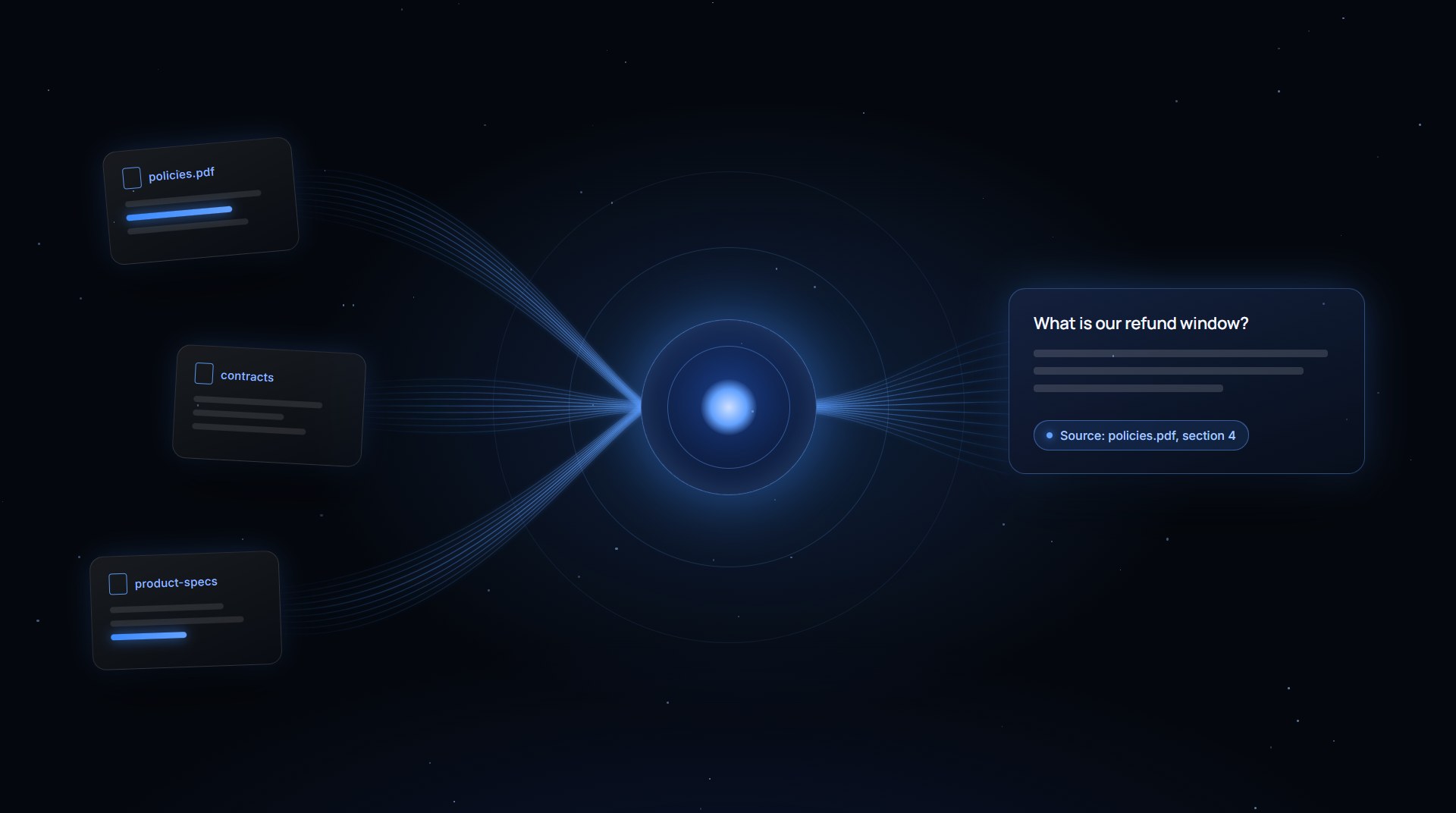
"Can we train an AI on our company data?" is one of the most common questions we get. It usually means something simple: you want an assistant that answers questions about your products, policies, contracts, or processes correctly, instead of guessing.
The confusing part is that "training" is rarely the right word. In most cases you do not need to train anything. You need to give an existing model the right information at the right moment. That technique is called retrieval-augmented generation, or RAG, and for most business use cases it works better than fine-tuning.
This guide explains both approaches in plain language, when each one makes sense, and what actually decides whether the project works.
The short answer
- Use RAG - when the AI needs to know facts: documents, policies, product data, tickets, anything that changes over time.
- Use fine-tuning - when the AI needs to behave differently: a fixed output format, a consistent tone, or one narrow task it repeats thousands of times.
- Use neither yet - when a well-written prompt with a few examples already gets you most of the way. Start there.
What RAG is, in plain words
RAG works like an open-book exam. The model does not memorize your documents. Every time someone asks a question, the system searches your content, pulls out the few passages most likely to contain the answer, and hands them to the model together with the question. The model then writes its answer from what it was just given.
A typical RAG pipeline has four steps:
- 1Ingest - Documents are collected from wherever they live: a shared drive, a wiki, a helpdesk, a database.
- 2Chunk and index - They are split into smaller passages and stored in a search index, usually combining keyword search with vector (semantic) search.
- 3Retrieve - When a question comes in, the system finds the passages most likely to contain the answer.
- 4Generate - The model answers using those passages, ideally citing where each part of the answer came from.
Because the knowledge lives in your index and not inside the model, keeping it current is easy. Update a document, re-index it, and the next answer reflects the change. No retraining.
What fine-tuning is
Fine-tuning takes an existing model and continues training it on your own examples, usually hundreds or thousands of input and output pairs. The model itself changes, so the new behavior sticks without long instructions in every request.
Fine-tuning is good at teaching a model how to respond. It is a poor way to teach it what is true. Facts learned through fine-tuning are hard to update, impossible to trace back to a source, and can blend with things the model invents. If your price list changes next month, a fine-tuned model keeps quoting the old one until you train it again.
RAG vs fine-tuning at a glance
- Best for - RAG: knowledge and facts. Fine-tuning: behavior, format, and style.
- Keeping it current - RAG: update the documents. Fine-tuning: retrain the model.
- Showing sources - RAG: can cite the exact passage it used. Fine-tuning: cannot point to where an answer came from.
- Access control - RAG: results can be filtered by who is asking. Fine-tuning: whatever the model learned is available to everyone who uses it.
- Upfront work - RAG: content cleanup and a retrieval pipeline. Fine-tuning: a large, clean, consistently labeled dataset.
- Typical failure - RAG: it retrieves the wrong passage. Fine-tuning: it answers confidently from outdated or blended knowledge.
When RAG is the right choice
Most business requests land here:
- Internal knowledge assistant - Staff ask about HR policies, procedures, or technical documentation and get answers that link to the source.
- Customer support - Answers drawn from help articles, product specs, and past tickets, with a handover to a person when the answer is not in the content.
- Contracts and documents - Finding clauses, comparing versions, or summarizing what a specific agreement says about a specific topic.
- Sales and product questions - Accurate answers about the current catalog, availability, or specifications, pulled from live data.
When fine-tuning makes sense
- Strict output formats - Producing structured data in exactly the same shape every time, at high volume.
- A narrow, repeated task - Sorting tickets into your own categories or extracting fields from one type of document, where a smaller fine-tuned model can be faster and cheaper than a large general one.
- A consistent voice - When prompting alone cannot hold a specific tone across thousands of outputs.
Even then, test a well-written prompt with a handful of examples first. Current models follow instructions well, and many teams find they never need to fine-tune. When they do, it is often combined with RAG: fine-tuning for the behavior, retrieval for the facts.
Do you need either of them yet?
Today's models can read very long inputs. If your knowledge base is small, say a few dozen pages that rarely change, you can often put it straight into the prompt and skip the retrieval pipeline. Each request costs more and runs slower than with RAG, but it is the fastest way to find out whether the idea is useful before you invest in infrastructure.
A sensible order is: prompt first, add retrieval when the content outgrows the prompt or changes too often, and consider fine-tuning only for a specific behavior problem that prompting cannot fix.
What actually decides whether it works
The model is rarely the bottleneck. These are:
- Messy source content - Outdated files, duplicates, and conflicting versions produce conflicting answers. Cleaning the content is often the biggest part of the project.
- Poor chunking - Splitting documents in the wrong places separates questions from their answers. Tables, scanned PDFs, and spreadsheets need special handling.
- Retrieval quality - If the right passage is never found, no model can answer correctly. Combining keyword and semantic search and reranking the results usually helps more than switching models.
- No evaluation - Without a set of real questions with known correct answers, you cannot tell whether a change made things better or worse.
- No "I don't know" - The assistant should say when the answer is not in the content instead of filling the gap with a guess.
Keeping your data safe
- Respect existing permissions - If someone cannot open a document in your drive, the assistant should not quote it to them. Filter retrieval by the user's access rights.
- Check how your provider handles data - Business and API plans from the major AI providers generally do not train on your data by default, but retention and logging settings vary. Review and configure them before sending anything sensitive.
- Leave out what is not needed - Personal or financial details can often be masked before indexing.
- Log questions and answers - You need an audit trail to review quality and investigate problems.
A practical way to start
- 1Pick one narrow use case - For example, answering questions about internal policies for one team.
- 2Collect 30 to 50 real questions - Together with the correct answers. This becomes your evaluation set.
- 3Clean the content for that use case only - Remove outdated and duplicate documents.
- 4Build the simplest version - Put the content in the prompt if it fits, use basic RAG if it does not.
- 5Measure against your questions - Then improve retrieval, prompts, or content based on what fails.
- 6Expand once it is reliable - Add more content and more teams after the first use case works.
The goal was never "an AI trained on our data." It is a system people trust enough to use, because it gives correct answers, shows where they came from, and admits when it does not know.
Frequently asked questions
Can I train ChatGPT on my company data?+
Not in the way most people mean. Uploading files to a custom assistant or connecting it to your documents uses retrieval: the model reads your content when it answers, it does not learn it permanently. Providers also offer fine-tuning through their APIs, but for company knowledge, retrieval (RAG) is usually the better fit because it stays current and can cite its sources.
Is RAG better than fine-tuning?+
For knowledge that changes or needs to be traceable to a source, yes. For a fixed output format, a consistent tone, or one narrow task repeated at high volume, fine-tuning can be the better tool. Many production systems use both: fine-tuning for behavior, retrieval for facts.
How much data do I need to fine-tune a model?+
Some providers report improvements from as few as 50 to 100 well-chosen examples, but most production fine-tunes use hundreds or thousands. The quality and consistency of the examples matter more than the volume.
Is it safe to use AI with confidential company data?+
It can be, if you use business or API plans with suitable data retention settings, enforce document permissions in retrieval, and log usage. In practice the biggest risk is often internal: an assistant that shows people documents they were never supposed to see.
How long does it take to build a RAG assistant?+
A focused prototype on clean content can take days to a few weeks. In real projects most of the time goes into preparing content, handling permissions, and testing answer quality, not into the AI model itself.
More Resources
Keep reading

What to fix before you automate anything
Automation can save time, but only if the process itself makes sense first. Otherwise you just speed up a bad system.

When an internal tool is better than another SaaS subscription
Sometimes the cheapest option is not another monthly subscription. Sometimes it is finally building the thing your team actually needs.

Why most software projects go wrong before development starts
A lot of failed projects are not development failures. They are decision failures that happened earlier and were never corrected.